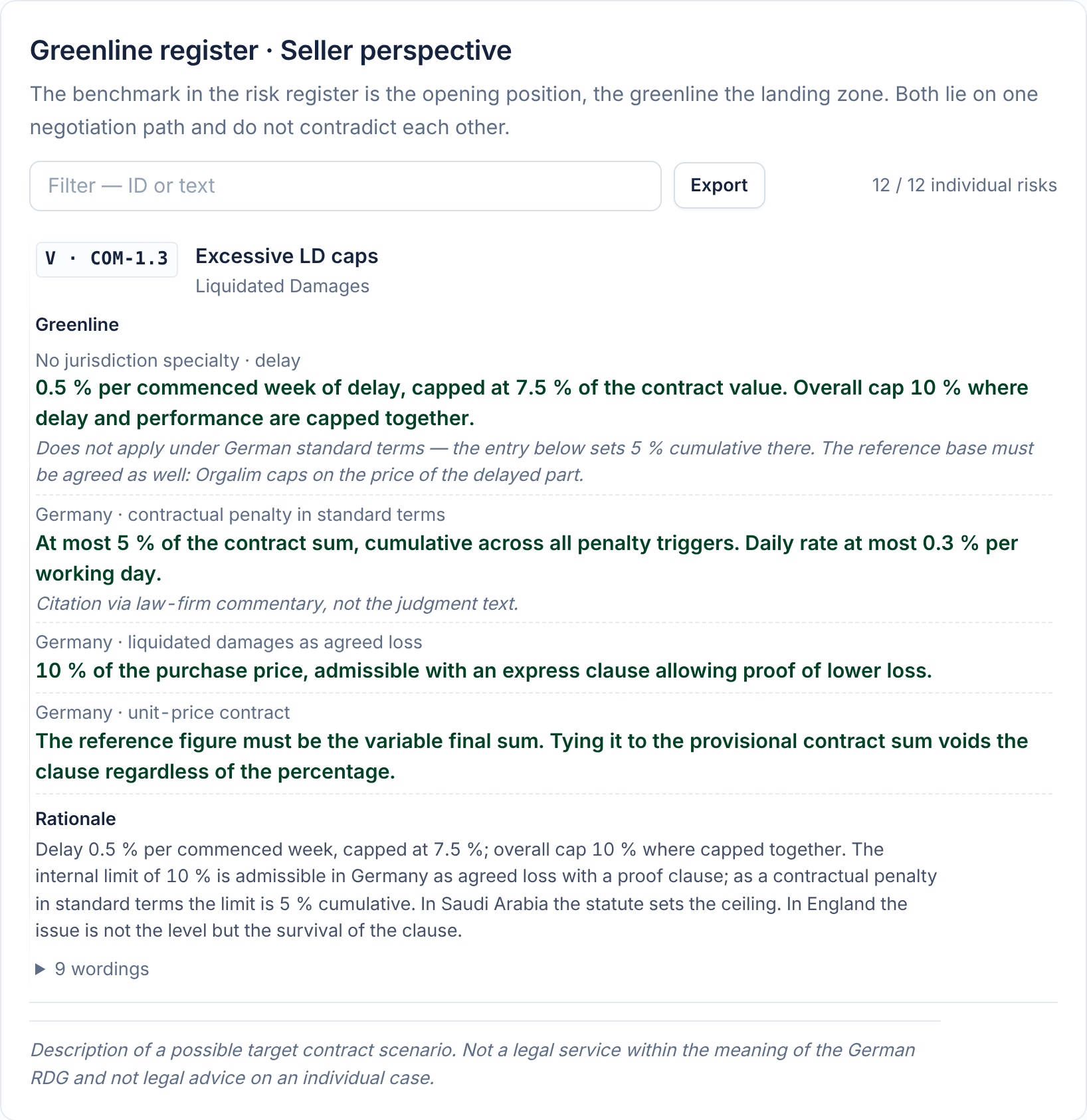
From 🟥 to 🟩 — A classic redline tells us what does not work. It marks the clause, names the deviation — and leaves the most important question open: so what does work, what is the greenline?
In international project business there is no single answer to that.
Take an excessive liquidated damages clause: the exact same wording leads to three different outcomes in three countries.
🇬🇧 England: it is struck out entirely where it exceeds the legitimate interest. No scaling down.
🇮🇳 India: it operates as a ceiling only, must be reasonable compensation, and requires actual damage to have occurred.
🇸🇦 Saudi Arabia: in government procurement the ceiling is statutory — 6 % for supply contracts, 20 % for all others. Not negotiable.
So: one fits all rules itself out.
That is why CLEVER introduces the greenline, a compromise line as its own column beside the benchmark. And it is conditional — on jurisdiction, contract form and the complexity of the scope supplied, each entry with its provenance. Where a line rests on practice knowledge rather than a citation, it says so.
The redline stays essential: it tells you what to change. The greenline tells you where to land.
Happy Selling 🙂
Juergen
💡 Note: description of possible target contract scenarios, not a legal service.