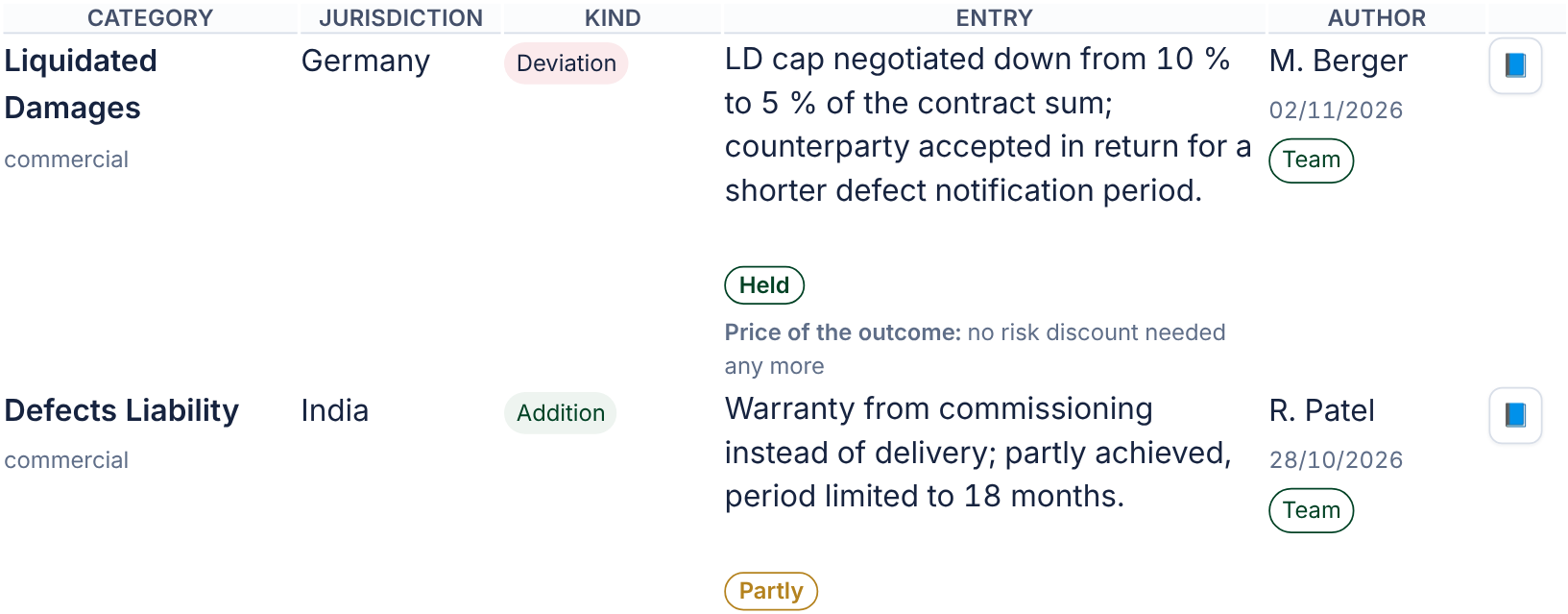
Lessons Learned in the project business? Usually an Excel row at the end:
"Termination for Convenience too vague." Useless for the next deal.
The costly reality behind it: a customer terminates early. Our cancellation schedule lagged behind the real cost curve — engineering running, long-lead items already ordered. We were left with the subcontractors' cancellation fees.
To prevent that, feedback has to hit the clause, not a spreadsheet.
CLEVER calls this Return of Experience — REX. It works in three steps.🎯
🔍 The context: project and contract managers log feedback right where they work — directly on the clause, while the deal is still running.
⚖️ The result: we tied the TfC to the real cost curve, included the subcontractors' cancellation fees and set a lower limit. CLEVER records how it ended — enforced, partly, conceded — and what the outcome cost.
⚙️ The scaling: when the same input is corrected three times in the same direction, CLEVER proposes an organisation-wide value — subject to approval.
Nothing takes effect before that.
Return of experience that flows back.
Happy Selling! 🙂
Juergen